Showing posts with label Essay. Show all posts

Monday, July 2, 2012

The Road to Here.

Margaret Overton, a high school classmate, published a book entitled, Good in a Crisis.  With witty humor and frank insights, Margaret peeled the bandages from the bleeding wounds of her mid life for all to see.  

This was a trying time for Margaret: nasty divorce, dating after a 23-year hiatus, near-death brain aneurism, date rape, the death of dear friends, and the declining health of her mom.  But this post is not a book review.  Instead, I feel like expressing my own comments on aging, roads not taken, acceptance and happiness. 

It was not just Margaret’s book that got me thinking, but also our circumstances.  She and I attended the same advanced placement high school classes in Elmhurst, Illinois.  She turned down Stanford for the six-year college/medical school program at Northwestern.  I turned down Northwestern for Stanford.  She lived in Chicago condos. I used to wonder how I’d have liked the Chicago lifestyle.  Margaret had, and probably still has, the good looks of Charlize Theron – Ashley Judd.  Brains and beauty.  I used to look like Brad Pitt. (Well, would you believe . . . Marty Feldman?)

A thought that crossed Margaret’s mind when she contemplated her own death from the aneurism was the “lack of lasting impact . . . a person such as me makes during life,” (p. 74) as if raising two daughters and keeping people alive in trauma centers were not enough.  Those of us in high school a. p. classes were children with high expectations for ourselves.  Those expectations drove us to set and achieve goals.  Such potential also creates the risk that we may deem ourselves failures for not setting and achieving higher goals.  If Jesus Christ, Harriet Beecher Stowe and Franklin Roosevelt are the role models, then we are doomed to feeling like losers.

Possessing great potential might have prompted Margaret’s following words, which saddened, angered and motivated me to write this post. While watching marathon runners pass their homes, she and her neighbors talked about their bad knees, etc.  She started “thinking about how life chips away at our potential, athletic as well as otherwise, and defines the roads not taken.” (p. 36)

On one level, we all have such thoughts as we age.  It’s too late for me to try out for the Chicago Cubs.  I can’t sprint 800 meters without disabling pain for at least a week.  What if I’d avoided my first marriage? 

Here’s the thing.  Even stem cells must differentiate; one cannot become a heart valve AND an optic nerve.  A tree cut to frame a house will not support a Marbled Murrelet.  Childhood potential must grow from myriad choices and circumstances into something.  A life spent building a business is a life not spent as a professional golfer. Potential will be exploited in some manner, thereby becoming unavailable for exploitation in another realm. Regardless of the road travelled, we are in this spot at this moment in time.  Accepting and working with our realities, I believe, is the key.

“Acceptance” can get a bad reputation when used as a waiver or release from diligence.  Acceptance, as I use it, is not a philosophy to support slackers.  One must continue to set and achieve self-directed goals.  The focus must be forward-looking and positive: the half-full part of the glass.  I accept the fact that I cannot run a marathon.  The reality is that I do not resemble Brad Pitt in the slightest.  But, I feel like I possess skills, abilities, and judgment that I could never have imagined 36 years ago.  Some potential is gone, but new potential exists. 

So, when my former classmate refers to life as chipping away at our potential, I acknowledge her declaration as an expression of her entirely appropriate depression, but I reject it as a statement of true fact.  Everyone reading this post has enormous potential that cannot be exhausted in one lifetime, I’d argue.

As for happiness, we all would benefit from consistently taking stock of the good things in life.  Some days I walk around Portland with a broad inner smile of appreciation for all that is around me: sights, smells, people and their works -- the wonderful things that others are doing that I cannot and need not do.  (Of course, other days I curse the clouds and read a book.) I marvel at the things I’ve witnessed in my life, from new technology to centuries-old temples.  As days become fewer in number after our mid lives, we must strive to make them better in quality.  For me, the quickest fix is to avoid that which makes me unhappy (e.g., news of global environmental Armageddon) and focus on what pleases me. 

Nevertheless, at times one cannot simply change channels because shit happens in our own lives.  It certainly happened to Margaret Overton.  As my sister urges, seize a good hour if you cannot carpe a full diem.  Zoom to focus on that pleasant spot of beauty or gratitude whenever there's a break in the shit storm.

This morning as we parted for our jobs, I hugged my wife and told her I loved her.  Honestly, I’d feel greedy to want much more.  

Monday, September 26, 2011

The places are ruined.

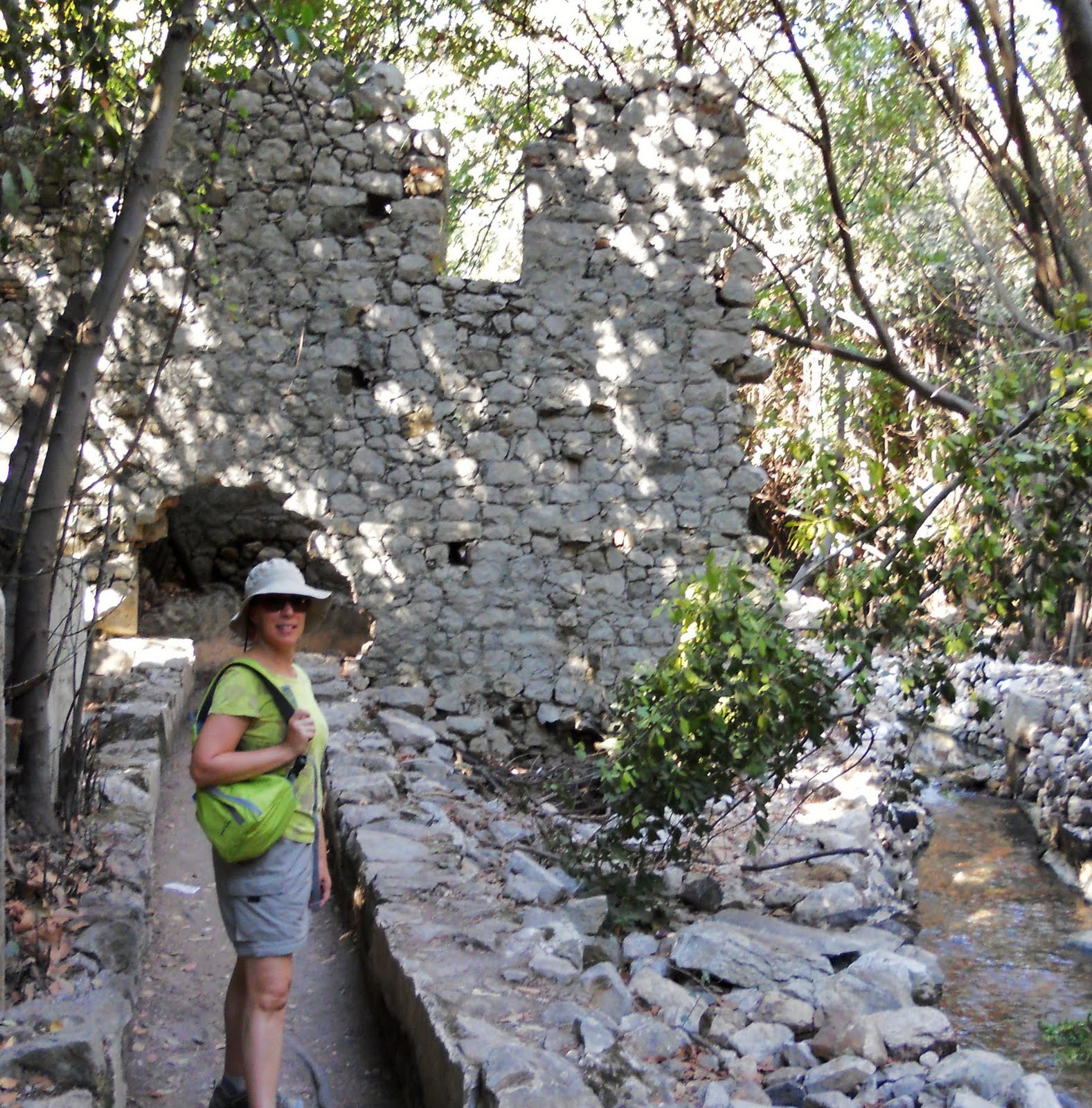
Why do busloads of tourists from all over the world visit ruins and pose for photographs like idiots (see above)? I don't know, but here are my thoughts upon visiting Ephesus, Aphrodesius and Olympos.

Ephesus was a great world city, with a population of 250,000. Like many ancient sites, it has the great sports stadium and a smaller odeon for civic debates. In that respect, nothing has changed: more people enjoy sports than debates. Because of St Paul's visit in about 52 A.D. and his writings, Christians enjoy walking the same streets of stone. Ephesus's main street was what struck me most.

The great library facade (pictured at top with the tourist), dominates the street, but what we found most interesting was the "Terrace Homes," which were the equivalent of New York Co-ops on Central Park: Lifestyles of the rich and long dead. Work continues on restoring the marble walls and mosiac floors. Some of the brick walls, covered with plaster, still have the paintings. The delicacy of the art and the taste of the owners survives these millenia later.

Aphrodesius has no great harbor to account for its founding and growth, which was more modest than Ephesus. It did have the temple of Aphrodite. Celebratory orgies might have been enough to attract and keep people there, at least until the Christians shut down that stuff after 500 A.D. The temple is not much to look at these days, but the three stadiums: sport, civics and theater, are in terrific shape. The museum at Aphrodesius displays gorgeous marble sculpture. The skill and delicacy of the work amazes. Earthquakes caused the fall of Aphrodesius and Ephesus. No FEMA to help rebuild.


Olympos lies just off a pleasant and partially sheltered beach on the Mediterranean Sea. Freshwater streams flow through the site (pictured above), which is overgrown. It would make for a beautiful hike even without the ruins, but the ruins make it look like something out of Indiana Jones. Pirates had much to do with the fall of Olympos.

My thoughts upon seeing formerly great cities and considering rise and fall of civilizations include the importance of wise & beneficent leadership and how necessary it is to deter pirates and invaders. It seems as though people have not changed over time in terms of appreciation of art and archeticture, the desire to build or plunder, and devotion to beliefs. We, in the United States, have less appreciation for the grand sweep of history than those who step over fallen granite columns for their Sunday on the beach, as they do here in Cirali, Turkey, site of Olympos.

More photos here.

Friday, September 23, 2011

Driving Rental Cars In Turkey

Driving in foreign countries can be enjoyable, interesting, challenging, and, we wonder, whether it can lead to an Interpol arrest warrant.

We've twice rented a car so far on this visit in Turkey. The rental process, itself, differed greatly from what we experience in U.S. airports. Both times, a person met us as we walked out of the terminal with the car. One time, we dropped the guy off. This second time, we drove to the cramped manufactured structure several kilometers away at a big gas station where we had to conduct business outside because there was no room inside.

Almira rentals provided us a car that is kind of a beater. Well, it IS a beater: worn seats, not the best tires, and a chipped windshield. When it rained, we learned that the windshield wipers need replacing. Although we had a pre-arranged deal, it was in Euros. But they could not take a credit card for Euros and wanted to charge us in Turkish Lira at an exchange rate that we questioned. Eventually, we negotiated a cash dollar exchange rate we liked better.

We've noticed that some of the street signs seem to be aspirational. People sometimes roll right through stop signs or turn right against the no right turn sign. In fact the right turn violation we witnessed occurred directly in front of a “Polis” car, which ignored it. A couple of times, on not-busy divided highways, we've seen people drive against the traffic on the shoulder, saving miles and gas compared to if they actually drove the correct direction and made a u-turn.

Driving is a great way to get off the beaten path and see great expanses of the country. Turkey has very diverse lands. Today, we drove through broad valleys with high hillsides covered in olive trees and conifers. Yesterday, we stayed at a place that looked like it was set in the Tuscany hillsides, with terraced hillsides covered with fruit and olive orchards.

Unfortunately, we do not always comprehend the local practices. In the little town of Urgup, we parked near the main square. When we returned, we had a slip that looked like a parking charge or ticket for 13.00 TL, about $9. When we turned the car in, we asked the guy about it, and he seemed to indicate it was no problem. (Although we're not always sure that those with whom we speak fully comprehend what we are asking.) Yesterday, when we approached the toll road on ramp, we took the side that, APPEARED to have a booth. But it was just a machine for people who had the frequent use cards, which we did not have. We figured we'd have some explaining to do when it was time to exit. When we reached the next big toll area, again, there was no obvious place to go and no people in booths. After slowing down to try to figure out best option, and hoping no truck would slam into our beatermobile, we went through the place with no wooden barrier. The siren shot off, but only momentarily. Dutifully, we pulled off to see if someone would approach so we could start our explaining. When no one appeared, we drove off. We'll see if a camera got the license and will trace to us. Fortunately, we did not pay by credit card, so, perhaps, the crappy rental car business will not be able to charge us.

I assume Interpol does not deal with parking violations and stealing a few miles on a toll road. So, we can focus, instead, on dealing with the traffic and the side streets. One narrow lane last evening provided some entertainment. It was very steep and paved with slate. Allyson got about half way up when gravity exerted more force than beatermobile, with its tires could counter, kind of like trying to climb an icy hill. But we survived that and a later place where she did about a 10-point turn to get on our way.

Part of the fun of traveling are the little unexpected adventures in between the hoped-for highlights.

Friday, September 16, 2011

Istanbul v. U.S. Domes: You be the judge.

I'd say that is a look of skepticism on Allyson's face as we approach Hagia Sophia, and rightly so. Sophie, as I call her, is billed as this great dome, greatest on the face of God's good earth. But the evidence proves that the greatest domes are in the United States of America.

Let's compare, for example, Cowboy's Stadium in Texas, which is still part of the United States, despite the overwhelming opinion of those of us in Oregon, who wonder how peoples with such different political views can both be Americans. Jerry Jones built Cowboy's stadium, so we'll call it Jerry's dome.

Sophie's dome is tall. So big that our blessed Statute of Liberty could do jumping jacks inside. But Jerry's dome is taller, with a much bigger area underneath. Jerry's dome is retractable, but not Sophie's. Jerry's dome has air conditioning. Sophie's dome? Nope. You can buy a cold beer in the Texas dome, but you can't even find a water fountain within Sophie, although there is a little store outside. No food inside Sophie's dome; not even a $9 hotdog; no public toilets, either.

Sophie's defenders point out that Sophie's place has some old mosaics. I would concede that true fact. But here's the rest of that mosaic story. The mosaics are beat up. And other parts of the old church were defaced by the Sultans who turned it into a mosque. But more to the point of U.S. superiority, Jerry has something better than static depictions of a few images, he's got a humongo jumbotron that has ever-changing mosaics that that show football replays. Take that, Sophie.

Local Byzantine chauvinists, when confronted with this evidence, will start whining about "apples-to-apples" comparisons: Emperor Justinian built the Sophie Dome in 537 A.D. These fanatical local patriots started putting down United States by asking, "What have you Americans got from the year 537? Oooh, a sandal woven of grass. I'm so impressed." (I don't think they really were impressed. I think they were disrespecting our historical record of leading sustainable lives for 10,000 years or more.)

I responded, "Did you hear me whining about bad officiating when Oregon lost to Auburn?" The blank stare on the face of the locals made me think they did not understand my reference to the 2011 College Football National Championship, which highlights their parochialism. So I had to return the subject to domes, "Even the Detroit Lions play in a superior dome in Michigan." Again, they shook their heads, as if I were the one who could not accept the facts.

Anyway, I come to a foreign country to try to be a personal Ambassador and build bridges to foreign peoples, but all I find are local cheerleaders who stubbornly cling to preconceived notions of their own superiority. Oh well, tomorrow is another day.

Sunday, September 11, 2011

University Days and Floating the McKenzie

Positive continuity and change, is how I'd sum up my thoughts on our overnight visit to Eugene, Oregon and the University of Oregon. The occasion was Allyson's 15-year reunion of her law school class. We started at the new, clean, and comfortable law school, directly across the street from Historic Hayward Field, the soul of USA's Track and Field.

About 22 people from various classes (not just Allyson's class) showed by 9:30 for a rafting trip down the McKenzie River. People came from Florida, California, and Colorado, among other places. Everyone was very pleasant, open and seemed comfortable in their own skins. I thought to myself that this is the reward for all of us going through the rigors of an education and then playing by the rules. We all were able to enjoy a Friday, around pleasant people, in a peaceful spot, excited about what was to come that day.

We drove upriver about 45 minutes and loaded onto 4 rafts. No wet suits, no helmets. The McKenzie at Fin Rock and below is no White Salmon River. Mostly, it’s a gentle float, where people can just enjoy conversation, the clean rushing water, and trees. This is the part of the Oregon people think of when they think of Oregon: Hills covered by green conifers covering hills cut through with and cold rushing water. An occasional splash of 50-degree water felt good on this 94-degree day. The McKenzie is where Herbert Hoover would come to recharge his batteries as he caught the daily limit of 75 trout. This is where the logging industry helped build this state and pay for the Universities. (Thank goodness Phil Night of Nike graduated from Oregon, because that's who pays for the university now.)

We returned to the school around 4:30, hustled to our hotel and cleaned up for the reception and banquet in the evening. Among the crowd was the class of 1961 for their 50th. 10 of 22 graduates were honored with the "Order if the Emerald," which, I guess, means you graduated, lived another 50 years, and showed up. Many of the men had distinguished careers. (Remember, I said "men.") It was a full room, and I found lawyers I knew to talk to, in addition to our friends from Allyson's class.

Following the banquet with all classes, the groups broke up into their own classes, and 16 women from the class of 1996 met in the law student lounge at the law school. (One man attended the dinner, but he went home to his wife and children.) 1996 was the first class when women outnumbered men. The 1961 graduates formed a fraternity – the 1996 grads formed a sorority. Continuity and change.

As an undergraduate, I was a bit bemused by middle-aged and older alumni who would put on Stanford gear and show up for games. On Saturday, I was happy to join alumni and other fans to fill Autzen Stadium to kick off the home season with a blowout featuring many big plays. Here's the first touchdown of the home season.

The University of Oregon is a happy place to be. The kids seem optimistic and energized. It’s hard not to recognize the personalities from my time at college. The faculty and staff are upbeat, intelligent and pleasant to be around. The campus is gorgeous, where the classic old brick buildings exist down the wooded paths from the new $200 million basketball stadium and alumni center.

Sunday, July 24, 2011

A Day to Live For

In the Pacific Northwest, some of us hang on through months of clouds for those perfect summer days. Friday was one of those. While much of the rest of the country sweltered in, and fretted about, the severe heat, we enjoyed perfect blue skies and flirted with 80 degrees.

I drove East through the Columbia River Gorge National Scenic Area. The rocky cliffs, foliage and water never looks the same. The water is higher or lower, white-capped or smoooth. The colors change, as do the shadows and quality of light. Although the Osprey family always seems to be at their nest, past the great waterfall, on the left.

North across the Hood River Bridge, we see the climatological edge, with few trees on the eastern slopes. To the west,fir-covered ridges framed the wild riot of colors and movement from the kite-surfers and wave runners.

At the mouth of the White Salmon River, fishing men bobbed in boats hoping for a good tug. Driving north, I see white-water rafters & kayakers enjoying the same same river at Husum and BZ Corners.

Finally, in Trout Lake, Washington, the sky is a deeper, purer, prettier blue, which sets off the brilliantly white Mt. Adams. The mountain is the constant. It's the "ahhh" at the end of the road. It is the source of so much the water I just drove past. The Mountain feels like a great, calming father.

People set tables and prepared food at the Grange hall for a gathering. Other people milled about up the street at the 100+ year-old First Presbyterian Church, discussing the sad turn. Then, inside, we wept over the passing of Tate Taylor, the sweet, talented young man who brought us all together on this, otherwise, splendid day in the Pacific Northwest.

Wednesday, June 29, 2011

Thank you, Nurse Jane

He did not know he was lifeless. He did not remember that he’d cooked a salmon dinner for his wife and nephew and then mowed the grass. He did not remember the chest pain. My brother just dropped. Just black -- like The Sopranos finale. No white lights of heaven or evil red imps escorting him to eternal flames.

Instead, his wife took charge. She called 911 and pumped his chest. A few minutes later, the paramedics arrived and continued pumping, defibrillating and radioing the hospital for guidance, because nothing worked. Sixty minutes later -- ONE HOUR OF CHEST PUMPS LATER -- the paramedics’ “last-ditch” gambit worked, and they hurried the body out of the suburban bedroom, down the carpeted stairs, and off to the hospital.

People who suffer out of hospital cardiac arrests usually die. Medical journals report survival rates of less than 1 in 10. And what is the quality of life if they live? The brain voraciously consumes oxygen, seizing 15 to 20% of what the lungs provide, even though the brain is only about 3% of total body mass. When my wife called, she was cagey. I was out of town questioning evasive jerks all day, so I put it to her directly, “Are you telling me that he is either going to die or be gorked?” “Yes,” she admitted.

Long story short: brother Ken survived without any anoxic brain injury that I detect. I want to share something one of the many things I thought about during the two weeks between my brother’s near death and his return home.

Nurse Jane works in Cardiac ICU. If statistics hold, then most of her patients do not leave the hospital alive. I raised that concept with her. She simply said that the folks in Cardiac ICU do the best they can.

Her answer was unduly modest.

Here’s the real question for all of us and how Jane answered it with her actions, not her words.

Question: If the odds were pretty good that you’d be the last person on Earth that someone would see, how would you behave?

What first struck me was that Jane wore make up, even though she worked her 12-hour shift helping an unconscious man on life support. When he showed some awakening, days later, Jane was a calming presence with her soothing voice and pleasant face framed by pretty blonde hair. Perhaps she put on her face because of self-respect. However, I believe it was to respect the people she serves.

At my prompting, Jane revealed her faith in God and her interest in learning Hebrew, so she could comprehend earlier versions of the Bible. With Jane’s scrubbed and conservative appearance, one would not imagine her in a tattoo parlor. Yet, there on her wrists were tattoos. They looked like Hebrew. “Yahweh,” she answered. Jane’s hands and wrists masterfully operated those 13 drips running into my brother. The hands of God, indeed.

Some people urge, “Live like there’s no tomorrow!” Jane got me thinking that maybe we should treat people like THEY have no tomorrow, and offer them the kindness and warmth we normally reserve for our dearest family and friends. Thank you, Jane (and each & every other caregiver).

Sunday, June 26, 2011

Midnight in Portland

6-22-2011

Picnic in a park, movie, and conversation highlighted my first full day of summer. Dina’s birthday celebration in Rockwood was a good opportunity to see my “cup of coffee” friends. Then, Allyson and I grabbed a bite to eat before seeing the movie Midnight in Paris.

I enjoyed Woody Allen’s essay on nostalgia and how one can overlook the contemporary avant-garde. In Portland, I suppose the vanguard includes those involved in the locavore and bicycle movements. I’m proud of the food in Portland: the restaurants, farmer’s markets, local brewers and spirit makers.

I’m shocked at how many bicycle shops I see around town. Just about every Portland neighborhood has one or more places to buy and repair bicycles. I noticed an ad for one that now includes an on-site cafĂ©. At rush hour, the designated bike lane on Williams Avenue is full. We’ve all seen bicycle couriers and pedi-rickshaws. But on Thursday, I saw this bicycle delivery truck in action.


What the locavore and bicycle movements have in common is that they offer something everyone can do to promote good for the world. You don’t have to be lawyer litigating the Endangered Species Act. You don’t have to worry about how Samuel Alito’s elevation to the Supreme Court has doomed the United States to Corporate Serfdom for at least the next generation. With the food and bike movements, everyone can do something today

After the movie, we walked to the Brassiere Montmartre, an establishment that has been around for decades. Woody Allen explores the concept of historical layers in a place, (which I explored previously).

Over a Pernod at the Brassiere, I considered a time in the 1980s, on a hot summer evening, when Knudson and I enjoyed a high-flying jazz band in the Brassiere. Back then, the tablecloths were paper and guests used Crayolas to draw. In fact, the bar sponsored art contests, and the walls used to be filled with some of the most amazing crayon drawings. Since the remodel, the Crayolas and the art are gone, replaced by a slightly more upscale look of wood, mirrors and exposed brick.

Even in modern Portland, the layers of history exist, they’re just not as widely known and respected as Paris in the 1920s. Ninety years from now will people wish they had been part of the Portlandia vanguard in the 2010s?

Wednesday, June 22, 2011

Lone Fir Pioneer Cemetery Reminds us to Eat, Drink & Be Merry.


My third June solstice of Carpesummer arrived without a visit to the Columbia Gorge Stonehenge. On the first day of summer, the second sunny & hot day of the year provided all Portlanders a burst of enthusiasm. We found our sunglasses and dug out our summer clothes from deep within our closets.

Although I’d driven past it 100 times before, yesterday was the first time I realized that the cemetery was the Lone Fir Pioneer Cemetery. I had time, so I took a stroll through, and it provided me with a bit of a mental challenge.

Initially, the cemetery met expectations: century-old trees over decaying century-old headstones. We all marvel over the dates and relations carved in stone. We read tributes from husbands who outlived their wives and children who buried their moms. There’s a peaceful, solemn beauty. Within the Lone Fir Cemetery lie many of the names which any Portlander would know: Banfield, Sellwood, MacLeay and Lane, to name a few. These names now designate to a highway, neighborhood, park and county.

Then, I noticed some modern black stones that were larger than the old stones in the corner I had been exploring. As I moved closer, I noticed that faces were etched in the stone: the digital age had reached the pioneer cemetery. Then, I noticed one stone did not use the English language, it was in Russian. And the names on others were Russian-sounding. I noticed several more.

I reacted. Initially, I was shocked by the modern stones in the old cemetery. They seemed out of place and out of character. They broke my mood of browsing through history. Then, I questioned my attitude: Am I prejudiced against Russians invading this very Oregonian place? Did I think that the modern has desecrated the antique?

Some of the old stones were not in English. Many of the old stones marked first-generation Oregonians. I’m the first of my family to live in Oregon. Obviously, the stone in the Russian language honors a woman who was the first generation of her clan to arrive here. She, too, was a pioneer, even if she did not arrive in a covered wagon.

Summer has arrived in Portland. My stroll through Lone Fir Pioneer Cemetery reminds me of the Biblical encouragement to live:

“And behold joy and gladness, slaying oxen, and killing sheep, eating flesh, and drinking wine: let us eat and drink; for to morrow we shall die.” (Isaiah 22:13)

“And I will say to my soul, Soul, thou has much goods laid up for many years; take thine ease, eat, drink and be merry.” (Luke 12:10).